
The Agoric Platform
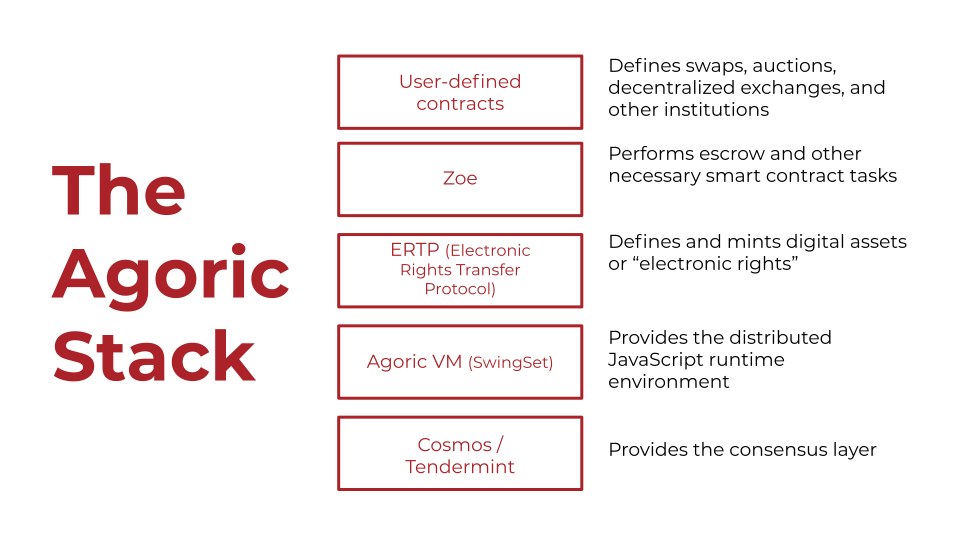
This document focuses on the layers beneath Zoe and ERTP, what we call the Agoric Platform. This includes "SwingSet", which can be thought of as our VM providing a distributed Javascript environment, as well as the Cosmos SDK and IBC.
SwingSet
On a single blockchain, or even a single machine with multiple users, it's very important to ensure that one user cannot prevent another user's code from executing and that the way in which code is interleaved doesn't open up hazards such as reentrancy. SwingSet solves that problem by dividing up the execution environment into vats. A vat is a unit of synchrony. This means that within a JavaScript vat, objects and functions can communicate with one another synchronously. Between vats, objects and functions communicate asynchronously, by design.
A physical machine can run one or several vats. A blockchain can run one or several communicating vats.
The internal state of a vat can be stored in a persistent memory so that the vat can be turned off and later turned back on (on the same or a different physical machine) by loading the stored state.
A SwingSet instance also handles communication between the vats it provides and the outside world. On a blockchain, this means writing to a part of the state that is intended to serve as an outbox. On a non-blockchain machine, this might mean sending a message to a remote machine.
SwingSet provides orthogonal persistence.
SwingSet also supports vat upgrade: a running vat can be pointed at a new code bundle without losing its durable state, so contracts and platform services can be fixed or extended in place instead of being redeployed from scratch. See the Orchestration guide for how the platform builds on this to let a contract hold and move assets across chains from a single durable, upgradable vat.
Cosmos SDK
The Agoric chain runs a single SwingSet instance with multiple vats on top of Cosmos SDK. SwingSet and most of our code is written in JavaScript, so we have a process that starts up the JavaScript environment, starts a SwingSet instance, and then connects through Go to the Cosmos SDK modules, the consensus engine (CometBFT), and back again.
Dynamic IBC
IBC is the protocol for Inter-Blockchain Communication. IBC enables messages to be sent from one blockchain to another with the use of intermediary relayers.
Dynamic IBC (dIBC) solves the problem of rolling out a new protocol on top of IBC without needing a platform upgrade or chain governance vote: a smart contract or VM platform can deploy new contracts that support new protocols, all on an existing chain. This is no longer just a proposal; it's the mechanism the Orchestration API uses today to let a contract open and manage ICA (Interchain Accounts) and IBC connections to other chains, and it's what the Fast USDC contract uses to move funds between Noble and Agoric.
For background, see a recent article on dIBC.
CometBFT
CometBFT is the consensus engine, defining how blocks are agreed upon and created. Effectively, CometBFT is the lowest level layer that defines the blockchain itself. (CometBFT is the actively maintained continuation of the project formerly known as Tendermint Core.)